What happens when you know the truth about God, but your heart remains unchanged? This message explores a dramatic moment in history when pride, power, and irreverence collide—and a faithful servant stands firm. Discover how genuine humility and a life that glorifies God can transform even the most challenging of circumstances.
What happens when you know the truth about God, but your heart remains unchanged? This message explores a dramatic moment in history when pride, power, and irreverence collide—and a faithful servant stands firm. Discover how genuine humility and a life that glorifies God can transform even the most challenging of circumstances.
Many years later King Belshazzar gave a great feast for 1,000 of his nobles, and he drank wine with them. While Belshazzar was drinking the wine, he gave orders to bring in the gold and silver cups that his predecessor, Nebuchadnezzar, had taken from the Temple in Jerusalem. He wanted to drink from them with his nobles, his wives, and his concubines. So they brought these gold cups, taken from the Temple, the house of God in Jerusalem, and the king and his nobles, his wives, and his concubines drank from them. While they drank from them, they praised their idols made of gold, silver, bronze, iron, wood, and stone. Suddenly, they saw the fingers of a human hand writing on the plaster wall of the king’s palace, near the lampstand. The king himself saw the hand as it wrote, and his face turned pale with fright. His knees knocked together in fear and his legs gave way beneath him. The king shouted for the enchanters, astrologers, and fortune-tellers to be brought before him. He said to these wise men of Babylon, “Whoever can read this writing and tell me what it means will be dressed in purple robes of royal honor and will have a gold chain placed around his neck. He will become the third highest ruler in the kingdom!” But when all the king’s wise men had come in, none of them could read the writing or tell him what it meant. So the king grew even more alarmed, and his face turned pale. His nobles, too, were shaken.
Belshazzar’s feast was more than a party; it was an act of defiant pride and irreverence toward God. Using the sacred vessels from the Jerusalem Temple for his own glory, he mocked the Most High and placed his confidence in idols. The sudden appearance of the hand writing on the wall shattered his sense of security and exposed the emptiness of his pride. How often do we—knowingly or unknowingly—treat the things of God lightly or rely on our own strength? God’s warnings are sometimes loud, sometimes subtle, but they are always an invitation to return to humility and reverence before Him.
Daniel answered the king, “Keep your gifts or give them to someone else, but I will tell you what the writing means. Your Majesty, the Most High God gave sovereignty, majesty, glory, and honor to your predecessor, Nebuchadnezzar. He made him so great that people of all races and nations and languages trembled before him in fear. He killed those he wanted to kill and spared those he wanted to spare. He honored those he wanted to honor and disgraced those he wanted to disgrace. But when his heart and mind were puffed up with arrogance, he was brought down from his royal throne and stripped of his glory. He was driven from human society. He was given the mind of a wild animal, and he lived among the wild donkeys. He ate grass like a cow, and he was drenched with the dew of heaven, until he learned that the Most High God rules over the kingdoms of the world and appoints anyone he desires. You are his successor, O Belshazzar, and you knew all this, yet you have not humbled yourself. For you have proudly defied the Lord of heaven and have had these cups from his Temple brought before you. You and your nobles and your wives and concubines have been drinking wine from them while praising gods of silver, gold, bronze, iron, wood, and stone—gods that neither see nor hear nor know anything at all. But you have not honored the God who gives you the breath of life and controls your destiny!”
Daniel courageously reminded Belshazzar of his own family history—how God humbled Nebuchadnezzar’s pride and restored him only when he acknowledged God’s sovereignty. Belshazzar “knew all this,” yet he chose pride over humility. Like Belshazzar, we often know what is true about God, yet fail to let that truth transform our hearts. Knowledge alone is not enough; God seeks hearts that are humble and responsive. The challenge is not just to remember God’s acts, but to let His truth shape us from the inside out.
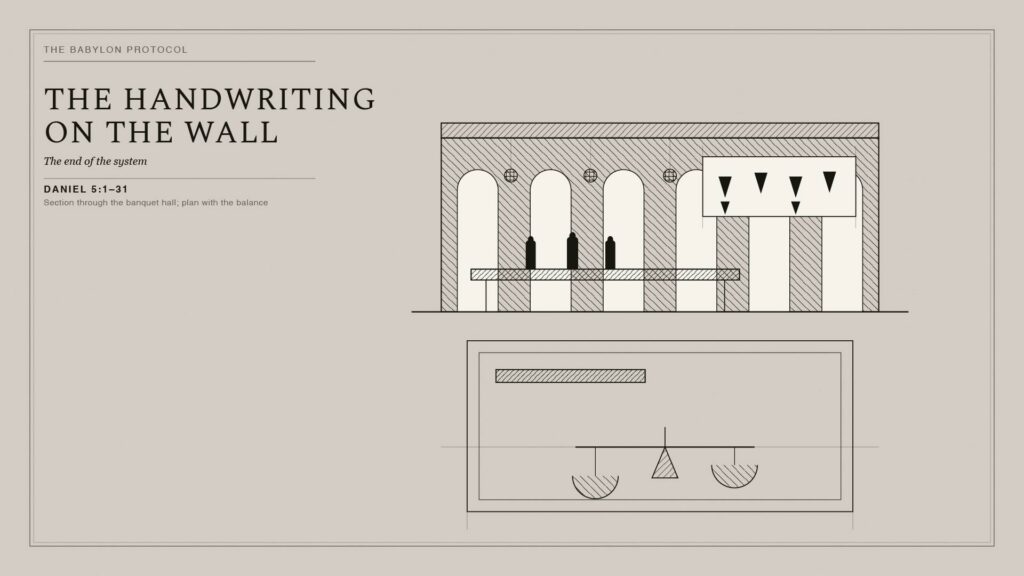
So God has sent this hand to write this message. This is the message that was written: Mene, Mene, Tekel, and Parsin. This is what these words mean: Mene means ‘numbered’—God has numbered the days of your reign and has brought it to an end. Tekel means ‘weighed’—you have been weighed on the balances and have not measured up. Parsin means ‘divided’—your kingdom has been divided and given to the Medes and Persians.”
The message written on the wall was God’s verdict: Belshazzar’s days were numbered, his life weighed, and his kingdom divided. God’s justice is not arbitrary—He weighs hearts, motives, and actions. While this message is sobering, it points us to an even greater hope: in Christ, we are measured not by our own merit, but by His finished work. Still, we are called to examine our lives, repent of pride, and live with holy reverence, knowing that God sees and cares about how we live.
And he gives grace generously. As the Scriptures say, “God opposes the proud but gives grace to the humble.” So humble yourselves before God. Resist the devil, and he will flee from you. Come close to God, and God will come close to you. Wash your hands, you sinners; purify your hearts, for your loyalty is divided between God and the world. Let there be tears for what you have done. Let there be sorrow and deep grief. Let there be sadness instead of laughter, and gloom instead of joy. Humble yourselves before the Lord, and he will lift you up in honor.
The message of James is clear: God stands in opposition to pride, but pours out His grace on the humble. Humility is not just a one-time act, but a daily attitude that shapes our responses, relationships, and even our self-perception. Daniel’s faithfulness stood in stark contrast to Belshazzar’s arrogance—he served God steadily, spoke truth with love, and was not swayed by earthly rewards or recognition. In our own lives, humility looks like surrendering our reputation, our plans, and even our frustrations to God, trusting Him to lift us up in due time. Faithfulness in the everyday—how we drive, speak, and treat others—becomes a way to glorify God.
In the same way, you who are younger must accept the authority of the elders. And all of you, dress yourselves in humility as you relate to one another, for “God opposes the proud but gives grace to the humble.” So humble yourselves under the mighty power of God, and at the right time he will lift you up in honor. Give all your worries and cares to God, for he cares about you.
Peter urges believers to “dress” themselves in humility, a conscious and visible choice. Humility shapes how we relate to others and to God, freeing us from the need to promote ourselves or carry our worries alone. Instead, we are invited to cast every care on God, trusting that He sees, knows, and values us. Like Daniel, we can live in a way that glorifies God in every season—when we’re seen and when we’re overlooked, when we’re honored and when we’re humbled. When God is the one who measures and lifts us up, we can rest secure and serve freely, knowing our value comes from Him.
A weekly guide to carry the conversation beyond Sunday morning.
Begin with a moment of prayer, inviting the Holy Spirit to reveal areas of pride, humility, and faithfulness in each participant’s heart as you reflect on Daniel 5.
Context:
The sermon opened with the familiar phrase “the writing’s on the wall,” describing moments when something is inevitable or a warning is clear. The preacher explained how this phrase comes directly from Daniel 5, where God’s message of judgment literally appeared on the palace wall.
Question:
Have you ever experienced a “writing’s on the wall” moment in your own life—a time when you saw a warning or a clear sign that things needed to change? What was it, and how did you respond?
Context:
The sermon emphasized Belshazzar’s knowledge of his grandfather Nebuchadnezzar’s story—he knew about God’s power, yet his heart remained unchanged. The preacher asked if we can identify something we know from God’s Word but haven’t allowed to shape our hearts.
Question:
Is there a truth from Scripture or a lesson you know well, but find difficult to truly live out? Why do you think there is a gap between knowing and living it?
Context:
Repeatedly, the message confronted pride and self-importance, highlighting how God “opposes the proud but gives grace to the humble.” Daniel’s life was contrasted with Belshazzar’s arrogance—Daniel remained humble and faithful, refusing earthly rewards and speaking truth even when it was not popular.
Question:
How do you see pride or self-importance showing up in your own life? What would it look like, practically, to humble yourself before God this week?
Context:
The preacher challenged the congregation to consider whether their words, desires, and actions genuinely glorify God—even in ordinary moments, like reacting to a rude driver or in conversations with others.
Question:
Think about your daily routines and interactions. Where do you find it most difficult to glorify God? What is one specific area or situation where you can invite God to be honored through your actions?
Context:
Daniel refused Belshazzar’s rewards, showing that his motivation was simple obedience to God—not personal gain. The sermon asked: Are we willing to serve God even when there are no obvious rewards or blessings?
Question:
Are there areas where you find yourself wanting to obey God only when there’s something in it for you? How can you reorient your heart to pursue obedience simply because God is worthy?
Context:
The GrowCard question from the sermon asked people to identify something they are well-versed in from Scripture, yet their heart remains unchanged.
Question:
Take a few quiet minutes to reflect or journal: What is something you know from God’s Word, but your heart still resists? Share (if comfortable) and pray together for genuine transformation.
Invite the group to pray for one another—specifically for humility, a soft heart, and the courage to respond to God’s truth not just with knowledge, but with changed lives.
Leader Tip:
Encourage honesty and grace. Remind the group that all of us, like Belshazzar and Nebuchadnezzar, need God’s mercy, and—like Daniel—can grow in faithfulness, humility, and steady obedience no matter the circumstances.
A weekly practice you can do beyond Sunday morning.
Compare temporary vs. eternal things. Ask: “What does God say really matters?”
A weekly practice you can do beyond Sunday morning.
Practice: Invest Eternal
What We Instruct Them to Do: Redirect time, money, or energy from something temporary to something eternal.
How-To: